
About this book
About this book
A generated clip is raw material, not a film. This field manual shows indie creators and working professionals how to turn AI video, image and sound generation into finished, deliverable films: from a first ninety-second short made in thirty days to studio pipelines with world models, Gaussian splats, LED volumes, performance capture and agents, with consent, rights and provenance built in from the first shot.
Synthetic Studios treats AI filmmaking as a production system rather than a prompt box. Part I walks through a complete first film and explains how diffusion, latent and world models work, enough to direct them. Part II covers pre-production: writing, look books, storyboards and previs, and the methods that keep a character recognisable from shot to shot, from reference images to trained LoRA adapters. Part III covers production with generated, captured and virtual cameras: directing video models, camera and motion control, photogrammetry, NeRFs and Gaussian splats, LED volumes and real-time engines, and performance capture, lip-sync, de-ageing and digital humans. Part IV covers editing, AI-assisted visual effects, voice and music with consent, colour, finishing and delivery specifications. Part V turns the practice into a pipeline with node graphs, supervised agents, cost, schedule and crew. Part VI covers copyright and clearance, the 2023 and 2026 guild agreements, Content Credentials and disclosure rules, and the research frontier. Tool details are date-stamped to November 2026; Kestrel Lane Pictures, the running example, is a composite studio. Appendices supply templates and a ninety-day plan.
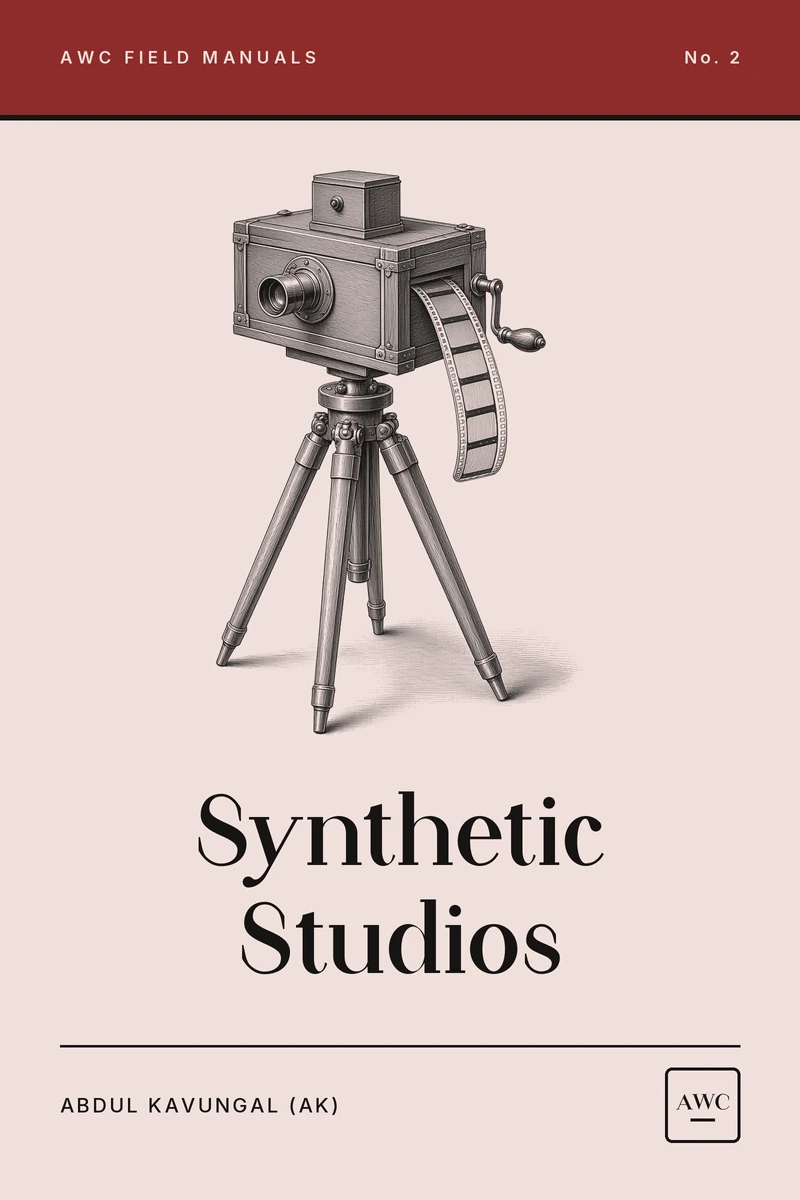
A generated clip is raw material, in the same way that a roll of exposed negative was raw material in 1895.
Contents
Chapters
- Preface
- Part IFirst Light
- Chapter 1The Studio in the Machine
- Chapter 2Your First Film in Thirty Days
- Chapter 3How the Models Work, Enough to Direct Them
- Part IIPre-Production
- Chapter 4Story First: Writing in the Age of Generators
- Chapter 5Look Books, Storyboards and Previs
- Chapter 6Casting the Synthetic and the Human
- Part IIIProduction
- Chapter 7Directing the Generator
- Chapter 8Camera, Motion and Control
- Chapter 9Capturing the Real: Photogrammetry, NeRFs and Gaussian Splats
- Chapter 10Virtual Production and the LED Volume
- Chapter 11Performances, Faces and Digital Humans
- Part IVPost-Production
- Chapter 12Editing the Synthetic Film
- Chapter 13AI VFX: Roto, Relighting, Cleanup and Upscaling
- Chapter 14Voice, Dialogue and Music With Consent
- Chapter 15Colour, Finishing and Delivery
- Part VThe Studio Pipeline
- Chapter 16Node Graphs and Agentic Pipelines
- Chapter 17Cost, Schedule and Crew
- Part VIRights, Labour and the Frontier
- Chapter 18Rights, Copyright and Clearance
- Chapter 19Labour, Consent and Ethics
- Chapter 20Provenance, Disclosure and Distribution
- Chapter 21World Models and the Road Ahead
- Appendix ATemplates
- Appendix BA Ninety-Day Plan
- Glossary
- Notes and References
- Index
Details
The edition
- Author
- Abdul Kavungal (AK)
- Publisher
- AWC · Award Winning Creations
- Series
- AWC Field Manuals, No. 2
- Category
- Technical
- Year
- 2026
- Pages
- 228
- Language
- English
- Status
- Published
55,658 words.
Read an excerpt
Chapter 1: The Studio in the Machine
On 28 December 1895, in a basement room of the Grand Café on the Boulevard des Capucines in Paris, a paying audience watched projected moving pictures made with a machine called the Cinématographe. Auguste and Louis Lumière had patented it in February of that year. It was a wooden box with a hand crank, a lens and an intermittent mechanism that pulled film past an aperture one frame at a time. What made it remarkable was not any single part. It was that the same box could record film, project it to an audience, and, with a light source behind it, print positive copies from the negative. Capture, duplication and exhibition fitted into something a person could carry.
The films were short, under a minute each, and simple: workers leaving a factory, a train arriving at a station, a baby being fed. Within a few years other filmmakers had worked out that the moving image could do much more than record. Georges Méliès used stop tricks, multiple exposures and painted sets to make people vanish and rockets land in the eye of the moon. Editors discovered that two shots placed side by side created a meaning neither had alone. The machine was the beginning. The craft was what people built around it.
That is a useful frame for what happened to filmmaking between 2024 and 2026. Machines arrived that could generate moving images from a sentence, a photograph or a rough performance recorded on a phone. Within two years they went from producing a few seconds of dreamlike, unstable footage to producing clips of fifteen or thirty seconds with synchronised dialogue and sound, consistent characters drawn from reference images, and resolutions that a colourist could work with. People made films with them, some of which played at festivals, some of which reached streaming services, and many of which nobody watched to the end.