
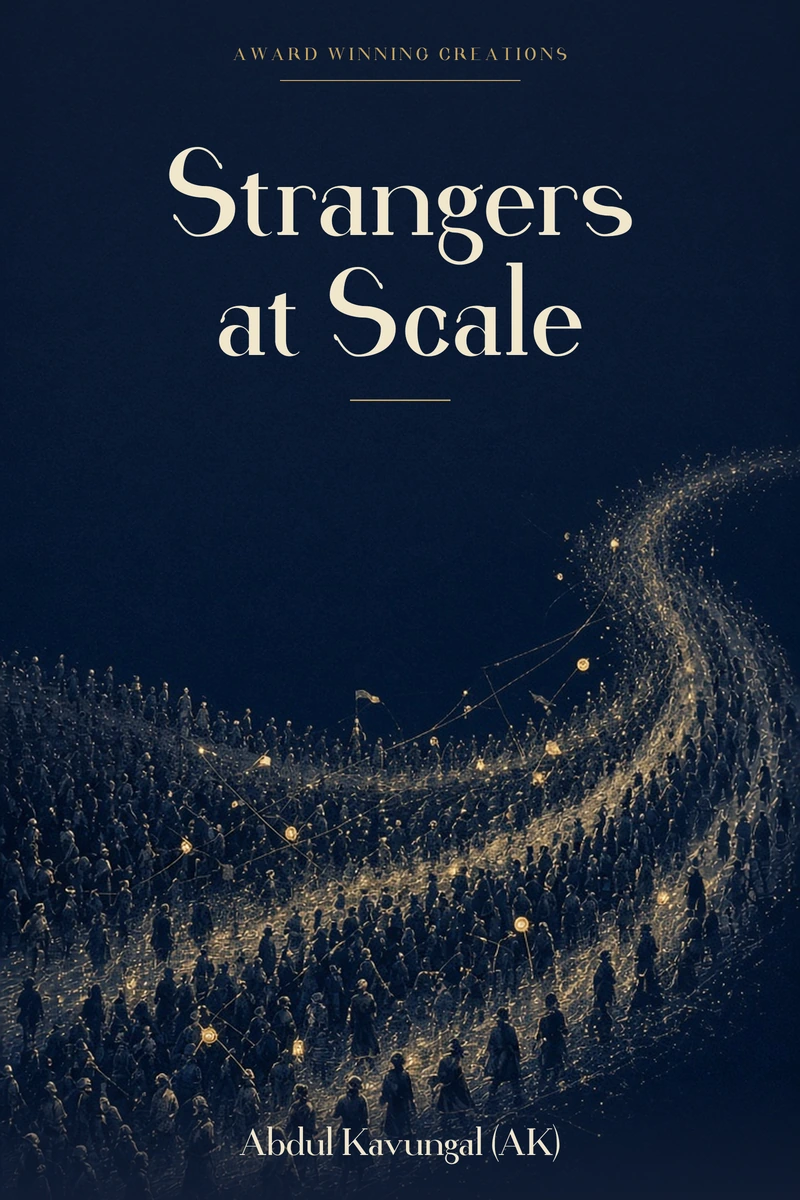
About this book
About this book
Humans are the only large animals that can walk into a city of millions and trust people they will never know. We do it by reading hidden markers: uniforms, accents, credentials, logos, money, star ratings. Strangers at Scale shows how those markers let trust outgrow kinship, and what happens when leaders forge, neglect or redesign them.
Strangers at Scale draws together three bodies of work: Mark W. Moffett's account of anonymous societies in The Human Swarm, Eric D. Beinhocker's evolutionary economics in The Origin of Wealth, and Donella H. Meadows's systems thinking in Thinking in Systems. The result is a practitioner's account of how companies, markets and platforms work as anonymous societies held together by markers. Across twenty-eight chapters and documented cases, from Gombe chimpanzees and Maasai cattle to bank balances, impostors, hospital uniforms, cross-border mergers, eBay feedback and Airbnb profiles, it explains why trust behaves like a stock that fills slowly and drains fast, why culture resists redesign after a merger, and how leaders can audit, design and repair the markers their organisations run on. It is an independent work of commentary and synthesis, not affiliated with or endorsed by the authors or publishers of the source books.
In 1974 a community of chimpanzees in Gombe Stream National Park, in what is now Tanzania, began to kill its neighbours. The victims were not strangers in the usual sense.
Contents
Chapters
- IntroductionThe Most Ordinary Miracle
- Chapter 1The Forest and the Carriage
- Chapter 2Billions Without a Quarrel
- Chapter 3Three Fingers in a Basement
- Chapter 4Born Reading Markers
- Chapter 5How Many People Can You Know?
- Chapter 6Real People
- Chapter 7Trust as a Stock
- Chapter 8Traps in the Marker System
- Chapter 9Wealth Is What a Society Agrees to Count
- Chapter 10Money, the Marker Everyone Carries
- Chapter 11Kinship's Long Shadow
- Chapter 12Differentiate, Select, Amplify
- Chapter 13Status, Fairness and the Instinct Beneath the Spreadsheet
- Chapter 14The Badge and the Brand
- Chapter 15Credentials and Licences
- Chapter 16The Great Impostor
- Chapter 17Uniforms and Dress Codes
- Chapter 18The Dialect of the Office
- Chapter 19Markers at a Distance
- Chapter 20When Two Tribes Sign a Deal
- Chapter 21Why Culture Resists Redesign
- Chapter 22Reputation Engines
- Chapter 23A Stranger's Spare Room
- Chapter 24Commons Without Kin
- Chapter 25Counterfeit Belonging
- Chapter 26The Marker Audit
- Chapter 27Designing Markers on Purpose
- Chapter 28Repairing Broken Markers
- ConclusionReal People
- Back Matter
- A Note on Sources and Method
- Notes and Sources
- Glossary
Details
The edition
- Author
- Abdul Kavungal (AK)
- Publisher
- AWC · Award Winning Creations
- Category
- Non-fiction
- Year
- 2026
- Pages
- 275
- Language
- English
- Status
- Published
70,901 words.
Read an excerpt
Chapter 1: The Forest and the Carriage
In 1974 a community of chimpanzees in Gombe Stream National Park, in what is now Tanzania, began to kill its neighbours. The victims were not strangers in the usual sense. A few years earlier they had belonged to the same community, the Kasekela group studied by Jane Goodall and her colleagues. A set of males and females had drifted south and begun to spend their time apart, until the researchers recognised them as a separate community, which they called Kahama. Over the next four years, Kasekela males made a series of raids into the southern territory. Moving quietly in groups, they found Kahama males alone or in small numbers and attacked them with a violence that shocked the field team. By the end of the episode, the Kahama community had effectively ceased to exist, and Kasekela had absorbed much of its range.
The episode, often called the Four-Year War, upended a gentle picture of our closest relatives. For a while some critics suggested that the violence was an artefact of human interference, perhaps caused by the bananas researchers had provided to bring the animals into view. Later evidence made that explanation hard to sustain. At Ngogo, in Kibale National Park in Uganda, John Mitani, David Watts and Sylvia Amsler documented a large chimpanzee community killing neighbours over roughly a decade and then expanding into the territory it had cleared, taking over an area equal to around a fifth of its former range. In 2014 a large team led by Michael Wilson compiled data from eighteen chimpanzee communities and concluded that lethal attacks were better explained as an adaptive strategy, a way of eliminating rivals when the risk to attackers was low, than as a response to human disturbance.
What matters for this book is not that chimpanzees are violent. Many animals are. What matters is the shape of their tolerance. Within a community, chimpanzees groom, share food, form alliances, reconcile after fights and care for orphans. They know one another as individuals, with histories, reputations and moods. Across the boundary of the community, that knowledge stops. An animal from the next valley is not a potential partner whose qualities can be discovered. It is an outsider, and the default responses to outsiders are avoidance or attack. The community ends where personal recognition ends.