
About this book
About this book
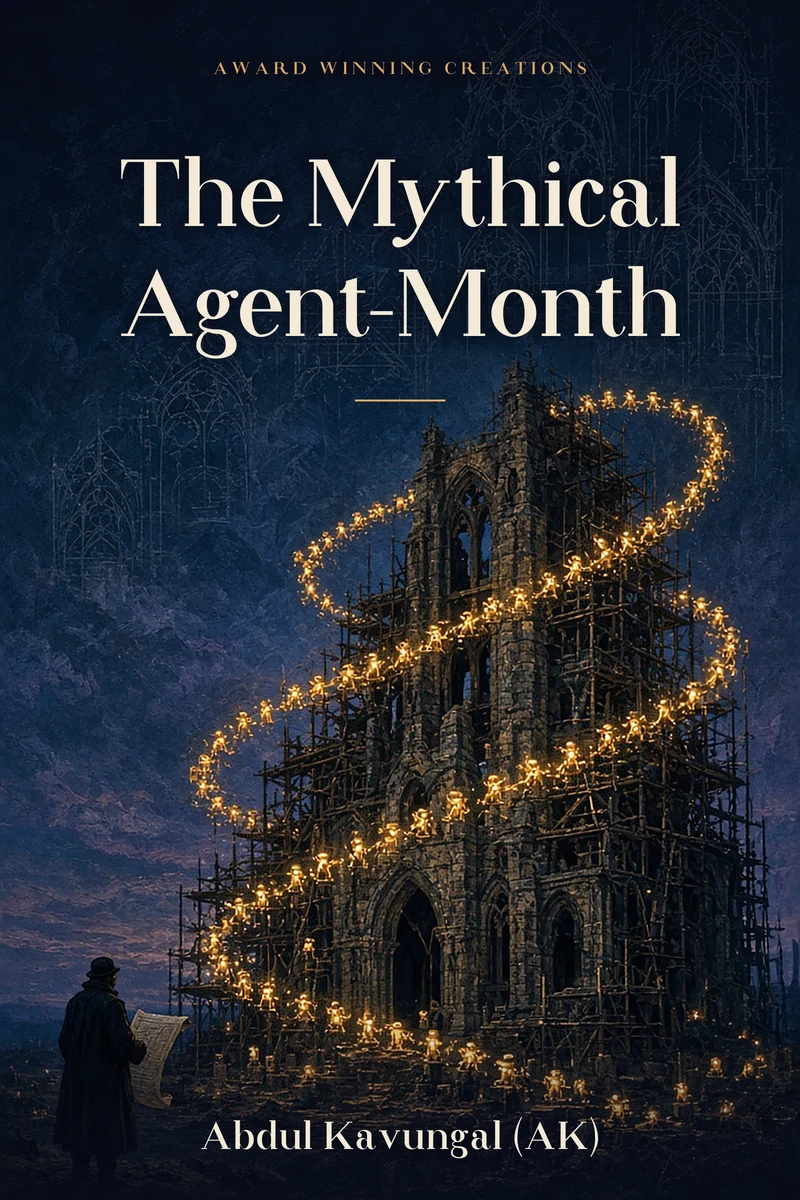
Half a century ago Fred Brooks warned that adding people to a late software project makes it later. Now the extra hands are AI agents, cheap, tireless and available by the thousand. This book shows why Brooks's Law still holds when the workers are machines, why early slippage gets explained away until it is expensive, and what actually rescues a late project.
The Mythical Agent-Month brings together three classics: Frederick Brooks's The Mythical Man-Month, Donella Meadows's Thinking in Systems and Karl Weick and Kathleen Sutcliffe's Managing the Unexpected. Part One redraws Brooks's Law as a reinforcing feedback loop and asks what really changes when AI agents make implementation cheap, separating the essential complexity of deciding what to build from the accidental complexity tools can remove. Part Two uses Weick and Sutcliffe's research on high reliability organisations to show how lateness hides, as warning signs are relabelled as routine, with cases from HealthCare.gov, the Mars Climate Orbiter, the Therac-25 and England's National Programme for IT. Part Three argues that conceptual integrity, held by an architect, matters more when workers are cheap, and shows how a written design playbook keeps humans and agents building one system. Part Four is the practical core: the walking skeleton over the perfect plan, testing before launch, limiting the blast radius of changes and agents, leverage points for a late project and a step-by-step rescue.
The meeting usually starts with a chart. A line that was supposed to slope gently down to zero by the end of the quarter has flattened into a plateau.
Contents
Chapters
- IntroductionThe Tempting Arithmetic
- Part OneThe Law and the Loop
- Chapter 1Nine Women, One Month
- Chapter 2The Loop Behind the Law
- Chapter 3Cheap Hands
- Chapter 4Essence and Accident
- Part TwoHow Lateness Hides
- Chapter 5The Reassuring Story
- Chapter 6Preoccupation with Small Failures
- Chapter 7Reluctance to Simplify
- Chapter 8Sensitivity to the Sharp End
- Chapter 9Ninety Percent Done
- Part ThreeConceptual Integrity When Workers Are Cheap
- Chapter 10The Cathedral and the Committee
- Chapter 11The Architect's Playbook
- Chapter 12Every System a Second System
- Chapter 13Documentation as a City Plan
- Chapter 14The Surgical Team, Revisited
- Part FourBuild It Small, Test It Early
- Chapter 15The Walking Skeleton
- Chapter 16A Boat Full of Holes
- Chapter 17Limiting the Blast Radius
- Chapter 18Resilience in the Unfolding Crisis
- Chapter 19Leverage Points for the Late Project
- Chapter 20A Rescue in Practice
- ConclusionWhat Can Rescue a Late Project
- Notes on Sources
- References
- Glossary
Details
The edition
- Author
- Abdul Kavungal (AK)
- Publisher
- AWC · Award Winning Creations
- Category
- Non-fiction
- Year
- 2026
- Pages
- 235
- Language
- English
- Status
- Published
73,486 words.
Read an excerpt
Introduction: The Tempting Arithmetic
The meeting usually starts with a chart. A line that was supposed to slope gently down to zero by the end of the quarter has flattened into a plateau. The burndown has stopped burning. Someone has added a red band across the top of the slide, and in that band are the words every engineering leader learns to dread: at current velocity, the release slips by eleven weeks.
For most of the history of software, the next move in that meeting was predictable. Somebody would propose more people. Borrow two engineers from the platform group. Bring in the contractors who did good work last year. Pull the strongest developer off the mobile app for a month. The arithmetic looked irresistible. If eight people produce a certain amount of work in a week, twelve people should produce half again as much, and eleven weeks of slip should shrink to something survivable.
In 1975 Frederick P. Brooks Jr. published a short book of essays that told the industry, in plain language, that this arithmetic was wrong. Brooks had managed the development of IBM's Operating System/360 in the middle of the 1960s, one of the largest software efforts attempted up to that point, and he had watched the arithmetic fail at scale. His book, The Mythical Man-Month, gave the failure a name that has outlived almost everything else written about software management in that decade. Brooks's Law, in his own phrasing, says that adding manpower to a late software project makes it later.
Fifty years on, the meeting has changed. The chart is the same and the red band is the same, but the proposal is different. Nobody suggests borrowing two engineers from the platform group. Somebody suggests spinning up twenty agents.
It is a reasonable suggestion on its face. The AI coding agents available to engineering teams in 2026 can read a repository, propose a plan, write code across many files, run the test suite, read the failures, and try again. They do not need a desk, a laptop, a security badge or a three-week onboarding programme. They do not get tired at four in the afternoon. They can be started in parallel, each on its own branch, each chewing on its own ticket. The cost of an additional worker, which for Brooks was measured in salary, recruitment time and months of ramp-up, has collapsed toward the price of compute. If Brooks's Law was a statement about the cost of adding people, and adding people has become nearly free, surely the law has finally been repealed.